5 hr 30 min
Tulum Ruins, Gran Cenote & Tacos Private Tour
- Private experience
- Personal attention
- Premium amenities
- Free cancellation
Gran Cenote Tulum — Snorkel Caverns & Turtle Pools
Clear water opens beneath the stone, turtles drift where light falls.
Compare fares, pick the fit — all bookings are mobile-voucher and eligible for free cancellation where shown.
5 hr 30 min
5 hr
6 hr
Worth it for early arrivers, skippable midday
At 500 MXN cash-only per person, gran cenote tulum sits mid-range for the area, and what you get back justifies it if you time your arrival. The gate buys you crystal-clear freshwater snorkeling over limestone, resident turtles gliding under the surface, and cave formations with stalactites hanging over open swimming channels. That combination of stalactites, turtles, and visibility is where the value lands. Most gran cenote tulum tours bundle transport and gear on top of the fee, so independent visitors paying only the gate come out ahead. The catch is timing: arrive at 08:00 opening and the water is calm and clear for photos; roll in after tour buses and the same 500 MXN buys crowded platforms and stirred-up silt. Book gran cenote tulum tickets as a solo entry and you avoid marked-up packages. This Tulum landmark pays off for snorkelers and first-timers who commit to an early start.
Bottom line: Commit to an 08:00 arrival and a gran cenote tulum tour delivers full value; show up midday and you overpay for crowds.
Gran Cenote Tulum wins on convenience and ease for families and first-time snorkelers, while Dos Ojos rewards divers chasing dramatic cave scenery. Most first-time visitors doing a single gran cenote tulum tour should pick Gran Cenote and add Dos Ojos only if diving is the priority.
|
Top pick Gran Cenote |
Dos Ojos | |
|---|---|---|
| Distance from Tulum town | 4 km (10 min drive) | 25 km north (25–30 min drive) |
| How you get there | Taxi, bike, or colectivo | Rental car, taxi, or colectivo |
| Underwater scenery | Open lagoon, tree roots, shallow caverns | Twin caves, stalactites, Bat Cave passage |
| Best for (snorkeling vs diving) | Snorkeling and casual swimming | Cavern and cave diving |
| Crowd levels | Busy by mid-morning, tour buses | Busy 9:30–10am, spreads out in park |
| Entrance fee | 500 MXN (cash only) | 400 MXN snorkel/dive (cash) |
| Typical time needed | 1–2 hours | 2–3 hours with dive add-ons |
| See tickets & prices |
Verdict: Choose Gran Cenote for an easy, close-to-town swim with the kids, and choose Dos Ojos when the goal is a genuine cave-diving experience worth the extra drive.
Hand-picked experiences loved by thousands of travelers
12 hours
Free Cancellation
Explore a Wonder of the World, swim in a jungle cenote & stroll colonial Valladolid — all in one epic day.
8 – 8.5 hours
Free Cancellation
Ancient Mayan cliffs, jungle swimming holes, and Caribbean views — all before lunch.
2 hours (guided) + optional free time until 5 pm
Free Cancellation
Explore four stunning cenotes in 2 hours with a certified guide, then swim freely until 5 pm.
Reach the toll booth at the entrance, pay the 500 MXN gate fee in cash, and rent a locker if needed.
Use the entry shower, collect a life jacket or rented snorkel mask, and store valuables in a locker.
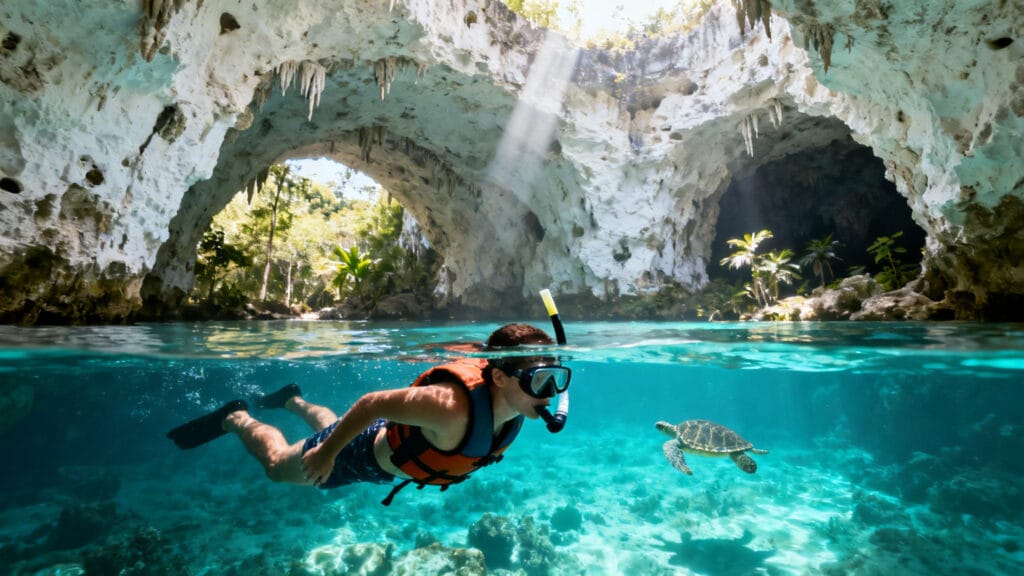
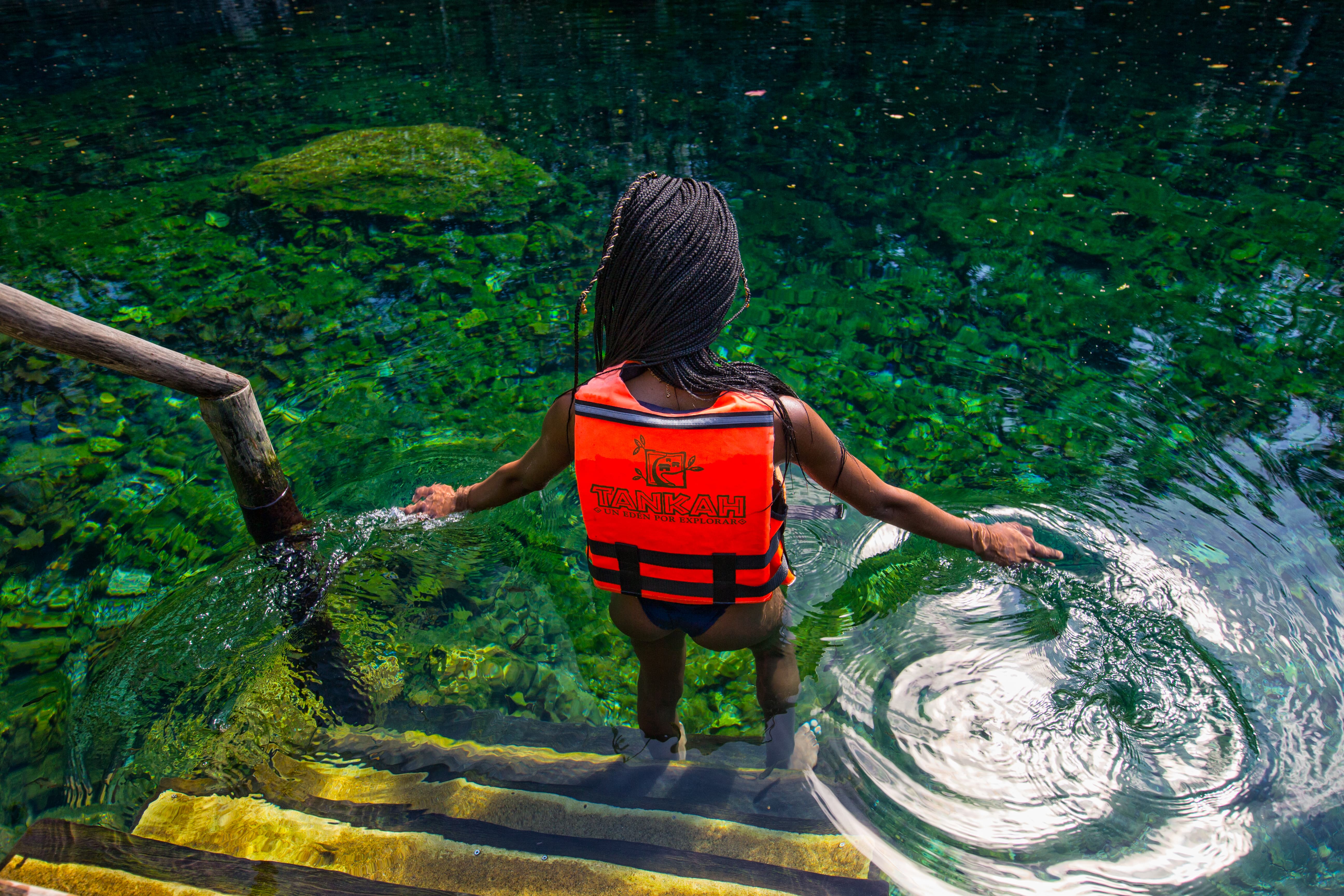
Snorkel the main sinkhole among freshwater turtles and small fish in clear, sunlit water.
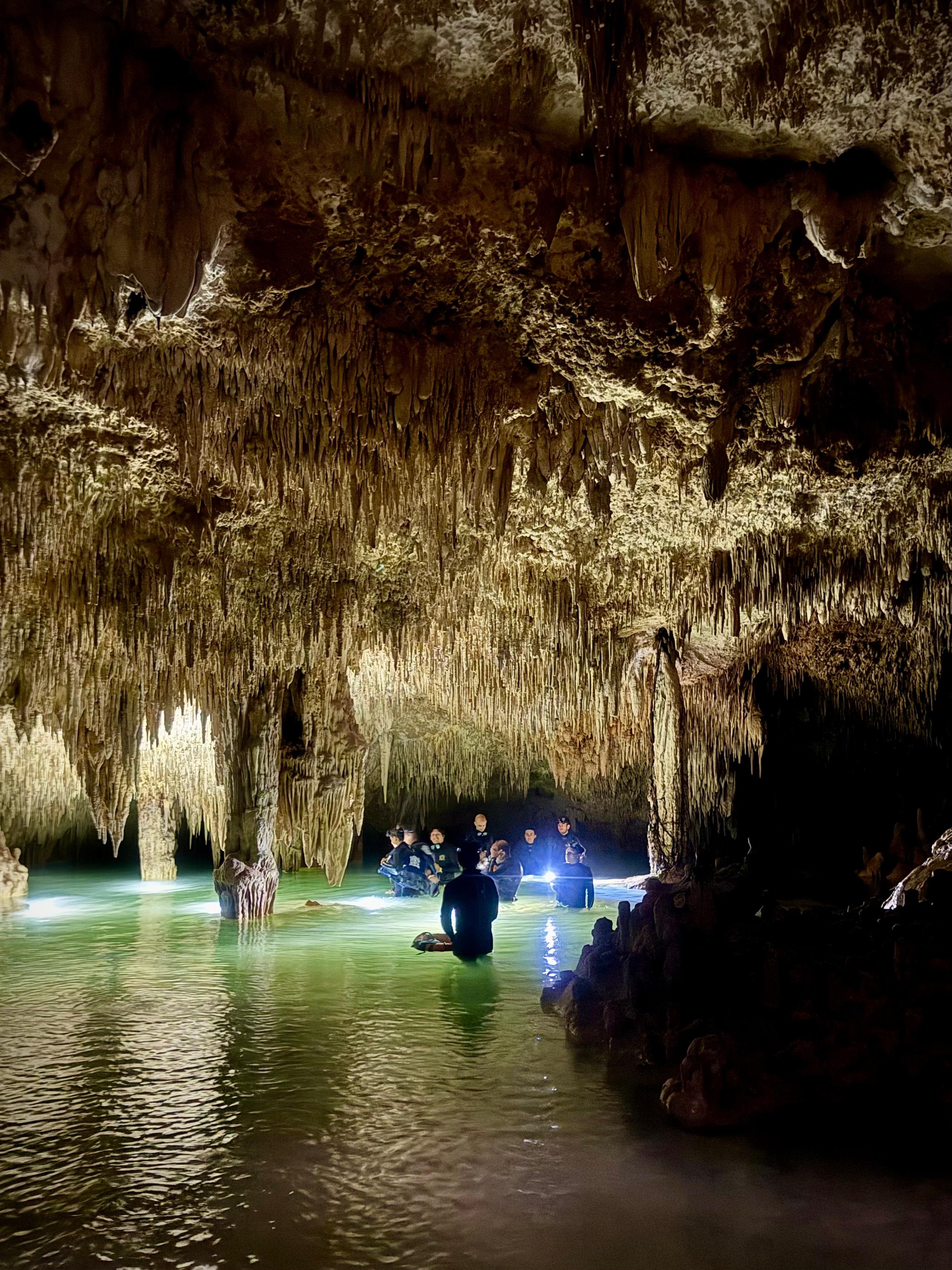
Follow the roped path into the connected cavern section, where bats roost overhead and light filters through the stone.
Relax on the wooden platforms or hammocks near the entrance before heading back to the parking area.
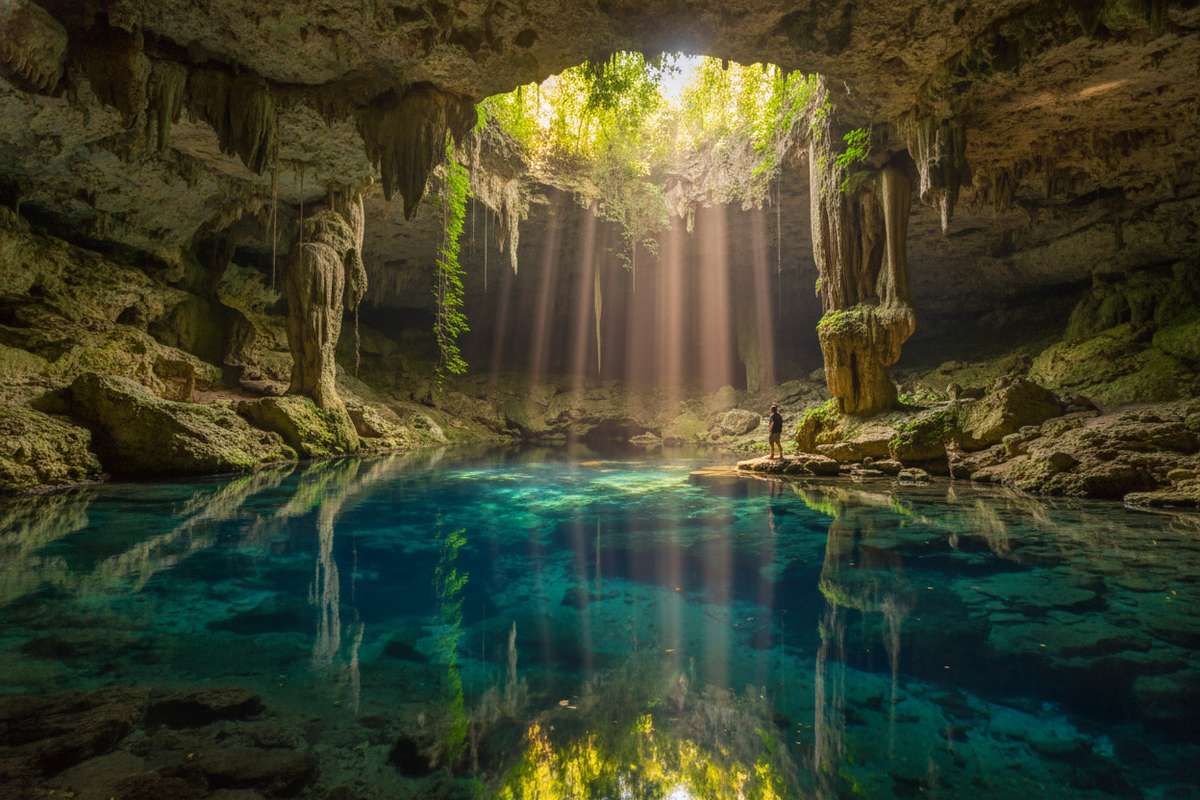
The main basin is the first swimming area visitors reach, with sunlit turquoise water over a limestone floor. Freshwater turtles frequently surface here, and it offers roughly 1,500 square feet of swimming space.
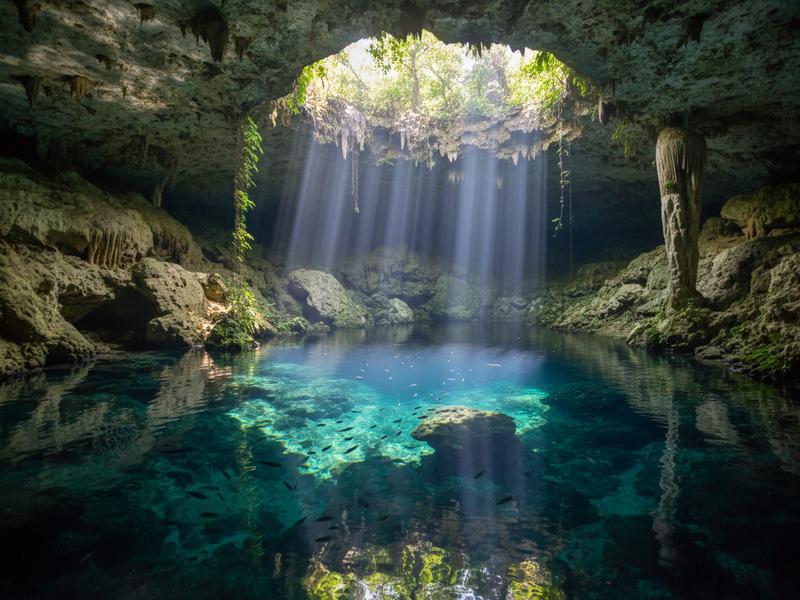
A roped underwater route connects the open basin to a low-ceilinged cavern where stalactites hang just above the waterline. Small bats roost in the darker sections, visible as snorkelers pass beneath with headlamps or natural light.
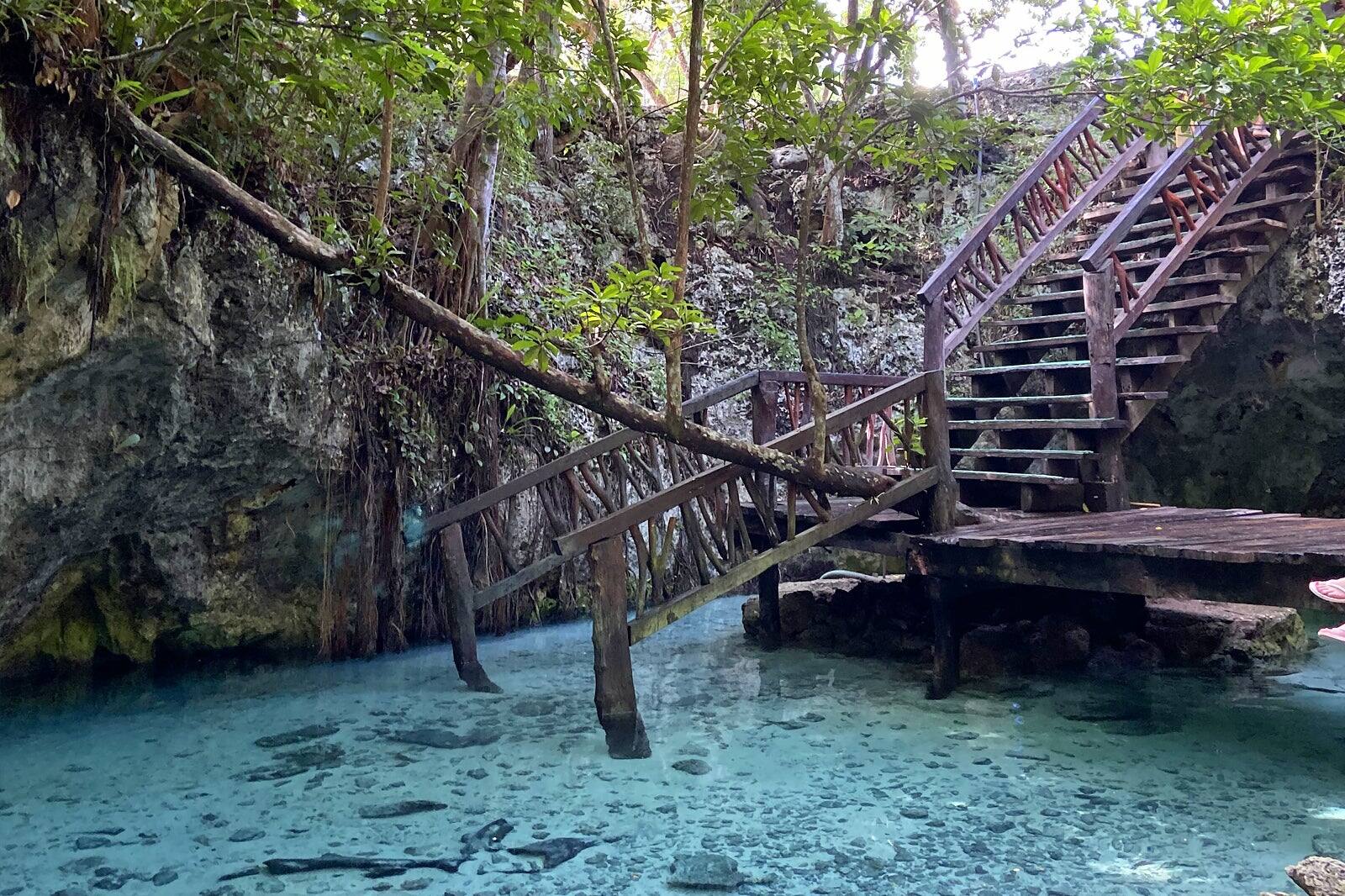
Raised wooden walkways ring the main sinkhole, connecting the entrance, lockers, and stairs into the water. They double as informal rest areas where visitors dry off between snorkeling sessions.
A short stairway with a rinse-off shower marks the transition point from the dirt path to the water, required for all visitors before entering. The shower also serves as the checkpoint where staff confirm sunscreen compliance.
Gran Cenote forms part of the Sac Actun system, one of the longest surveyed underwater cave networks on Earth at over 380 kilometers mapped. The visible opening at the cenote is only a small fraction of this much larger flooded cave network beneath the jungle.
You turn off the Cobá road and pay the 500 MXN gate fee in cash, then follow the boardwalk down through the trees. At the changing rooms you rinse off — a required shower keeps sunscreen out of the water — and stow your bag in a locker before descending the wooden stairs to the first pool. You wade in from the shallow ledge, and the cold catches you for a second before the clarity takes over. Pulling on your mask, you drop your face beneath the surface and the floor falls away into blue. A turtle noses along the sandy bottom below you, unbothered. You follow the rope line strung across the water toward the low arch where the open pool feeds into the cavern. Ducking under the stone lip, you enter the shaded chamber. Stalactites hang close overhead and daylight filters in behind you, throwing rippled patterns across the rock. You float quietly, listening to the drip echo, then swim back into the sun. A raised walkway lets you cross to the second pool, where fewer swimmers linger and the light angles differently through the afternoon. You climb out, dry in the warm air, and take the boardwalk loop back past the turtles one last time. Many gran cenote tulum tours end here, but on your own you can simply stay until the shadows lengthen.
All the details about your upcoming adventure in one place
Gran Cenote Tulum is a spring-fed swimming and snorkeling spot where clear freshwater pools connect to a limestone cavern system along the Yucatan Peninsula. Set among mangrove roots and stalactites, this cenote near the Maya ruins draws snorkelers, freshwater turtles, and small fish through its interconnected sinkholes. Booking gran cenote tulum tours in advance secures your entry and lets you plan around the site's daylight hours.
The limestone shelf beneath the Yucatán Peninsula holds no surface rivers at all; every drop of fresh water travels underground, and where the roof of a flooded cave collapses, a cenote opens to the sky. Gran Cenote tulum is one such wound in the rock, a linked pair of pools and half-drowned caverns roughly four kilometres from the modern town, set just off the Carretera Tulum-Cobá at kilometre marker 109. The ancient Maya read these openings as thresholds. The word derives from dzonot, a Yucatec Maya term for a sacred well, and across the peninsula such sinkholes served as sources of drinking water and as portals to Xibalba, the underworld of the Popol Vuh. Communities settled around them because nothing else guaranteed water through the dry months. The dense network of flooded passages that threads this region forms part of the Sac Actun system, among the longest surveyed underwater cave systems on Earth, and divers still map new corridors each season. Geologically the site is young and old at once. The bedrock is ancient marine limestone, compacted seabed lifted over millions of years, yet the cavern ceilings collapsed comparatively recently, geologically speaking, exposing stalactites that formed when these chambers stood dry above a lower sea level. Those mineral formations now hang partly submerged, a record of vanished air written in calcite. Freshwater from rain meets denser saltwater intruding from the coast, and the boundary between them, the halocline, shimmers like liquid glass to anyone who swims through it. Today the pools shelter a small resident population of freshwater turtles and shoals of tiny fish that move through beams of light angling down from the openings above. Bats roost in the darker recesses, and the cave walls carry the slow drip of ongoing formation. The clarity is the draw: visibility often exceeds thirty metres, which turned this once-quiet swimming hole into one of the region's most photographed sites and a fixture on lists of Tulum landmarks. Gran Cenote tulum sits within a wider archaeological landscape, a short drive from the clifftop ruins of Tulum and the taller pyramids of Cobá, so the cenote reads less as an isolated attraction than as one chamber in a vast karst cathedral. Understanding that lineage — sacred well, water source, dive frontier — is what separates a quick dip from a genuine encounter with the geology and belief that shaped the peninsula.
Where the roof of a flooded cave collapses, a cenote opens to the sky — a threshold the Maya read as a door to the underworld.
Swimwear is expected in the water, with a rash guard or cover-up useful for the walk between the parking area and the entrance. Only biodegradable, reef-safe sunscreen is permitted, and staff may ask visitors to rinse off regular sunscreen under the entry showers before swimming.
A small toll office at the entrance handles the gate fee and locker rentals, and bags are subject to a quick visual check before you pass through. Lockers cost around 30 MXN and require an ID left as deposit, which is the standard system at gran cenote tulum rather than a coin-return locker.
Handheld cameras and GoPro-style action cameras are allowed throughout the open-air and cavern sections, but underwater flash photography is discouraged near the bat roosts in the cave tunnel. Drones require prior authorization and are turned away at the gate without it, and tripods used for commercial shoots need separate permission from site staff.
Life jackets are provided free of charge and are required for young or non-swimming children in both the open sinkhole and the connecting cave tunnel. Shallow steps near the entrance give small children a place to wade before heading into deeper water.
The path from the parking area to the water crosses packed dirt and wooden boardwalks with stairs down into the cenote, which makes wheelchair and stroller access difficult. There are no ramps into the water itself, and visitors with mobility limitations should plan for staff assistance or a companion at the entry steps.
Eating and drinking are not permitted in the water or on the wooden platforms around the cenote, and there is no restaurant on site. A small snack stand near the entrance ticket booth sells drinks and light bites for before or after your swim.
Quietest weekday mornings
Busier ahead of weekend
Heaviest tour bus traffic
Hours
Daily 08:00–16:45, last entry 16:15
Address
Carretera Tulum-Coba, Quintana Roo 109, 77796 Tulum, Q.R., Mexico
Terrain
Wooden platforms and stairs into water, uneven jungle paths
Best light
Morning sun through cave openings, 08:00–09:30
Lockers
Available on site, small rental fee, ID required as deposit
Car · 10 min · Free parking on site
Drive north from Tulum Pueblo on the Coba road (Carretera Tulum-Coba) for about 5 minutes; free parking is available at the site.
Taxi · 10-15 min · Approx. 200-300 MXN one-way
Taxis from Tulum town run directly to the gate along the Coba highway and are the simplest door-to-door option.
Bike · 20-25 min · Bike rental cost only
Cyclists can rent a bike in Tulum Pueblo and ride the mostly flat Coba road out to the cenote.
Public transport · 15-20 min · Approx. 25-50 MXN per person
Colectivo vans heading toward Coba depart from central Tulum and can drop passengers near the entrance on request.
Gran Cenote charges a 500 MXN gate fee per person in cash at entry rather than a prepaid ticket, so there is no refund window for the entrance fee itself. Third-party gran cenote tulum tours booked in advance typically allow free cancellation up to 24 hours before the scheduled time, per the individual operator's policy.
Recommended time
2-3 hours
A 2-3 hour visit at gran cenote tulum comfortably covers a swim in the open pools, a snorkel past resident turtles, and a slower paddle into the cavern sections where headlamps pick out stalactites overhead. Trim toward 1.5 hours if you just want a quick dip; stretch closer to 3 if you're renting gear or waiting for the cave chamber to clear of other swimmers. Queue reality shifts hard through the day: arrive at the 08:00 opening and you'll likely walk straight to the water, but show up mid-morning and you may stand behind a line of tour groups before the gate even lets you through.
Crowd levels through the day
Weather · crowds · average price — dots go green to amber to red as each metric rises.
Dry season with daytime temperatures around 26–28°C and lower humidity, drawing peak holiday crowds around Christmas and New Year. Water visibility is typically at its best during these cooler, drier months.
Warm, dry weather in the low 30s°C with spring break bringing a temporary surge in visitors during March. April and May tend to be calmer shoulder-season months.
Hot and humid with temperatures near 33–35°C and afternoon rain showers common. Cenote water offers welcome relief from the heat, and July sees steady but not overwhelming visitor numbers.
The wettest months, including peak hurricane season risk in September and October, with lighter crowds overall. November brings drier conditions and cooling temperatures into the high 20s°C.
The gate only accepts Mexican pesos, so bring small bills for the 500 MXN entry fee and any locker or gear rental.
Regular sunscreen is checked at the entrance and staff may ask you to rinse off before entering the water, so apply biodegradable sunscreen at your hotel beforehand.
Phones and cameras are easily splashed in the cave tunnel section, so a simple waterproof pouch protects electronics during the swim.
Snorkel masks and life jackets are available for rent on site, so travelers with their own gear can skip an extra cost.
The wooden walkways around the cenote get slippery when wet, so water shoes help on the steps down into the water.
Since it sits a few minutes down the same road, pairing a visit here with Gran Cenote makes an efficient two-cenote loop.
The ID-deposit locker system means losing a key can complicate leaving the site, so keep it clipped to a swimsuit or bag strap.
Carretera Tulum-Coba, Quintana Roo 109, 77796 Tulum, Q.R., Mexico
Ticket booth and locker rental are directly inside the gate
Get directionsThe sloped wooden boardwalk descending into the gran cenote tulum basin is the single most-photographed frame here, with jungle canopy framing the stairs and turquoise water below. Stand partway down the steps and shoot toward the water for the classic vertical composition; expect a short queue since other visitors line up for the same angle.
The open, C-shaped sinkhole stretches roughly 150 meters and gives the widest unobstructed water shot, bordered by limestone walls and overhanging roots. Shoot from the main wooden deck at the pool's edge to capture the full curve of the water alongside swimmers and turtles.
A quieter secondary wooden staircase leads to a smaller, less crowded pool on the far side of the site, offering a cleaner background with fewer people in frame. It's a good backup angle when the main staircase is busy with waiting visitors.
Inside the connected cave sections, hanging stalactites catch shafts of light filtering through cracks in the ceiling, creating a naturally backlit silhouette effect over the water. Snorkel or wade toward the cave mouth from the main pool to line up the light against the rock formations.
The narrow bat-cave channel linking the two sinkholes frames swimmers in a tunnel of rock, with light spilling in from both open ends. Photographing from within the water looking toward the exit produces a strong silhouette against the bright opening.
Visiting gran cenote tulum with young kids means calm, shallow entry platforms rather than a jump-in cave adventure, which makes it one of the easier stops for nervous swimmers and toddlers alike. Compared with the deeper, tunnel-heavy jungle cenotes near Coba, the open sections here give parents room to hang back on the steps while children get used to the water.
The parking area and entrance path are flat, but stone edges around the water are uneven, so plan to fold the stroller and carry younger kids the last stretch.
Toddlers and early swimmers do best sticking to the shallow, guide-roped section on the right; save the dark far-left cave for kids who are already confident underwater.
Showers, changing rooms, lockers, and gear rental sit right by the entry stairs, making quick clothing changes and life-jacket fitting straightforward for families with small children.
Budget slow, frequent breaks: let kids acclimate on the entry platform first, then move toward the cave-roofed area only once they're comfortable, rather than rushing a gran cenote tulum tour in one lap.
Snacks and drinks from home are allowed, and there's shaded picnic space plus food stalls outside, so a tired toddler doesn't mean cutting the swim short.
Because much of the swimming happens under open sky with only one shaded cavern, a light rain doesn't spoil the visit the way it would at fully covered cenotes.
Real experiences from real travelers
We arrived right at opening and had the shallow pool almost to ourselves for twenty minutes. The gran cenote tulum lived up to the photos, with visibility so clear I could watch small turtles paddle across the limestone below me. Bring your own snorkel gear if you have it since the rental line grew fast.
The freshwater was refreshingly cold after the drive in from the coast. Sunlight came through the jungle canopy in bright shafts and lit up the whole pool. If you swim into the darker cave section you can see stalactites hanging just above the surface.
By late morning the main pool filled with people, so the calm I felt early on faded quickly. Still, one of the better cenote snorkeling spots I tried near Tulum, and the bat cave passage was a nice surprise. Wooden decks made it easy to get in and out of the water.
Floating quietly in the cavern, I could hear bats overhead while fish drifted below me. Among the gran cenote tulum tours I compared, going independently at dawn felt like the right call for smaller crowds. The mangrove roots reaching into the water made for lovely underwater views.
The water was so transparent it looked almost invisible over the pale rock. We spotted a couple of turtles resting near the edge and a small catfish gliding past. Sunlight and the surrounding jungle made the swim feel peaceful once the tour groups thinned out.
I grabbed my gran cenote tulum tickets ahead of time and arrived before the buses, which made a real difference. The limestone formations and hanging roots in the cave section were the highlight for me. Water shoes helped on the slightly slippery steps down.
Late afternoon light turned the surface a deep green-blue and the air smelled of wet stone and leaves. Snorkeling near the cavern edge, I drifted past clusters of tiny fish and one shy turtle. This gran cenote tulum tour section of our trip ended up being the part everyone talked about at dinner.
Being local, I have swum in many cenotes, and the clarity here still impressed me. Early on a weekday the pools were quiet enough to hear birds in the surrounding jungle. The connected caverns give you more to explore than a single open pool would.
We showed up around noon and it was packed, which took away from the experience. The gran cenote tulum tickets were straightforward to sort out, but I would strongly suggest coming at opening instead. Once I found a quieter corner the turquoise water and stalactites were lovely.
Swimming from the sunlit pool into the shadowy cave felt like moving between two worlds. Tree roots dangled to the waterline and bats fluttered under the rock ceiling above me. The freshwater visibility made watching the turtles below effortless.
Everything you need to know for your journey
Gran Cenote is open daily from 08:00 to 16:45, with last entry at 16:15, so plan to arrive well before mid-afternoon.
The paths and stairs down to the water are not wheelchair-friendly, since the site relies on wooden boardwalks and steps rather than ramps.
Regular sunscreen, insect repellent, glass containers, drones without authorization, and food in the swimming areas are all restricted at the gate.
Handheld cameras and GoPro-style devices are fine throughout the open-air and cave sections, though drones need prior approval and underwater flash near the bat roosts is discouraged.
Arriving between 08:00 and 09:30 at opening is the most effective way to beat tour buses, since the site fills up quickly by mid-morning.
Swimwear with a light cover-up for the walk to the entrance works well, along with water shoes for the wooden platforms and cave steps.
Food and drinks are not permitted in the water or on the platforms, though a small snack stand near the entrance sells items for before or after your swim.
Taxis from Tulum Pueblo reach the gate in about 10-15 minutes, and colectivo vans heading toward Coba also stop nearby for a lower cost.
Yes, free life jackets are provided and shallow steps near the entrance give younger children a place to wade before the deeper sections.
The 500 MXN gate fee is paid in cash on arrival and is non-refundable, though many prebooked gran cenote tulum tours from operators allow free cancellation up to 24 hours ahead.
The clifftop Tulum Archaeological Site and the smaller Cenote Calavera both sit a short drive away and combine easily with a morning at the cenote.
Tickets are not sold online; entry is paid in cash at the gate, so no advance gran cenote tulum tickets purchase is required for independent visitors.
Clifftop Maya ruins overlooking the Caribbean Sea, including the El Castillo structure. It is one of the few Maya sites built directly on a coastline.
A smaller open-air cenote known for its three natural entry points, including a jump-in skylight opening. It sits close to Gran Cenote along the same road toward Coba.
A jungle-set Maya ruin complex home to Nohoch Mul, one of the tallest pyramids in the Yucatán Peninsula. Visitors can rent bicycles to cover the wide site.
The town's central plaza area lined with restaurants, shops, and a church, forming the hub of downtown Tulum.
Beachfront boutique hotels and eco-chic resorts along the coastal road south of the ruins.
The town center offers a mix of mid-range hotels and guesthouses within walking distance of restaurants and bus connections.
Small jungle-set lodges and cabanas scattered along the Coba highway near several cenotes.
A newer residential and hospitality district between the town and hotel zone with a range of guesthouses.
Join thousands of happy travelers who have discovered this incredible experience
Book Your Experience Now